
How can we Unite the Struggle for Gender Equality?
This year’s International Women’s Day takes place against a backdrop of unprecedented geo-political upheavals. Donald Trump, defined legally as a sexual predator after being found guilty by a New York jury of having sexually abused magazine writer E Jean Carroll and then defamed her by branding her a liar, is now the leader of the world’s most powerful economic and military country. His unapologetic and brazen misogyny includes boasting that women let him “grab ‘em by the pussy”. The world over Trump’s second coming has emboldened the neo-liberals including the far right. Their reactionary campaigns against women have been given legitimacy. They will ramp up attacks on women’s rights that have unfolded over decades now as part of a general offensive against the rights of working class people.
Trump has returned to the US presidency with arguably the most openly right wing reactionary programme in the advanced capitalist countries in decades. Trump represents a wing of the US ruling capitalist class desperate to reverse the US’s economic decline at the expense of the working class and the rest of the world.
Trump is ripping up the international “rules based order” the US had been the principal architect of. It was constructed at the end of World War 2 firstly and foremostly to ensure the dominance of US imperialist interests. That order has failed to maintain the US’s position as the world’s sole economic, political and military hegemon. A new multi-polar world has emerged reflected in the rise of China as the US’ global rival. As he deconstructs that order, Trump is jettisoning even his “liberal” European allies of the 80-year-old post World War 2 international order with imperialist arrogance. Trump 2.0 represents the ushering in of a new era of world political instability and accelerating the developing global capitalist crisis.
Prominent in the weaponry in Trump 2.0’s foreign and domestic policy arsenal are an organised assault on the democratic, human rights, multiculturalism and equality between races and women that had served as a cover for US imperialist interests. His misogyny takes its place alongside racism and xenophobia in this neo-liberal onslaught. It is consciously calculated to divide the working class along the lines of gender, race and nationality to roll back all the gains of working class struggle over the last century including the right to vote. His henchman, the Nazi-saluting Elon Must has used his X (formerly Twitter) platform to promote attacks on abortion and contraceptives as well as the right of parents without children to vote to “save civilisation” – views that border on the Nazi ideology of Aryan racial supremacy.
UN Women’s latest report Womens Rights in Review 30 Years After Beijing marked the UN International Women’s Day on 8 March and 30 years since the adoption of the 1995 Beijing Declaration. It reports that a woman or girl is killed every 10 minutes by a family member or intimate partner. A quarter of governments worldwide reported a backlash on women’s rights. 35 countries reported a backlash on gender equality. They come from across the globe and include Spain, Germany, Canada, Netherlands, Philippines, Brazil, Peru, Lebanon, Jordan, Tunisia, Australia, Mongolia, South Africa, Mali and Zimbabwe.
UN Secretary General Antonio Guterres commented: “Digital tools … are also often silencing women’s voices, amplifying bias, and fuelling harassment, … Women’s bodies have become political battlegrounds … online violence is escalating into real-life violence. Instead of mainstreaming equal rights, we are witnessing the mainstreaming of chauvinism and misogyny.” Inspired by the reversal of Roe vs Wade (that upheld a woman’s right to choose to have an abortion) after 50 years, Poland and Hungary are mounting their own attacks on women’s right to abortion. Argentina President Melei, ally of Trump who handed Elon Musk a chainsaw in a public meeting to symbolise social cuts, has abolished the Department of Women. Melei is now campaigning to remove the crime of femicide from the penal code.
The Orchid project reports that every 12 minutes, a girl dies as a direct result of female genital mutilation/cutting (FGM/C). That’s 5 girls in an hour, 120 girls a day, 44,320 girls every year, lives lost to a practice without a medical purpose. Female genital mutilation/cutting (FGM/C) affects over 230 million women and girls around the world. It is a global issue that occurs in over 90 countries across Africa, Asia, the Middle East and within diaspora communities worldwide.
Nothing demonstrates US and European imperialism’s barbarism more clearly than its diplomatic and military support for the Israeli regime’s genocidal war on Gaza. Israel has dropped more than 70,000 tons of bombs on the Gaza Strip since last October, far surpassing those on Dresden, Hamburg, and London combined during World War II. 70% of the 61 000 killed in this holocaust are women and children. This is highly likely to be an underestimate. The Lancet’s study estimated the death toll to have been 40% higher by June 2024. The small number of Palestinian hostages Israel released report that the Israeli Occupation Forces engage in rape and torture of women and children. Israel’s genocidal war is a laboratory experiment of the brutality and barbarism of capitalism and imperialism.
Trump 2.0 is the most egregious example of the global capitalism’s determination to reverse all the gains that working class people and women have made through struggle over the past century and taken further over the last 80 years. The Stalinist political counter-revolution in the former Soviet Union incorporated attacks on women’s rights won through the October Revolution in 1917. The neo-liberal economic policies that have gained ascendancy over 50 years are now finding expression on the political plane. The policies being driven by Trump and his right wing allies worldwide are returning capitalism to its pre-Word War Two liberal norm. As always, women bear the brunt of these crises—economic turmoil, austerity, and war.
Trump 2.0 – Impact on SA
In SA, Trump’s unilateral withdrawal of aid for vulnerable populations—particularly those dependent on services funded by USAID’s PEPFAR programme—has already had devastating effects. 50 000 are still dying from HIV/Aids as the country grapples with the consequences of the disastrous Mbeki HIV/Aids denialism that claimed over 300 000 lives. This disaster has been aggravated by the ANC Government’s neo-liberal economic policy, the Growth Employment and Redistribution (Gear) strategy. Imposed on the country in 1996, Gear in reality is SA’s economic and political elite’s adaptation of the Washington Consensus – neo-liberal policies developed in the US and exported worldwide since the early 1970s.
Whilst PepFar enabled the health department to place 5.8m on treatment, 2.2m are not. The infections rate for adolescent girls and young women stands at one thousand a week. What the US has given with PepFar it the ANC government took away with austerity cuts in the health budget. Per capita spending on health has declined for ten years consecutively now including during the Covid pandemic.
Many women have lost access to essential services like HIV/AIDS treatment and reproductive healthcare. Thousands of healthcare workers, including nurses and HIV/AIDS counsellors, have been retrenched. Community-based programs supporting survivors of violence and orphans have been decimated. This comes when the healthcare system is already in crisis, following years of health spending cuts. Once again, the most marginalized suffer first and hardest.
Women in South Africa continue to battle a range of socio-economic, political, and cultural challenges. Austerity and right-wing populism reinforce gender oppression on which capitalism relies. Only the socialist transformation of society can bring about real gender equality. Below we propose demands that we intend to develop further through an engagement with women’s organisations. These demands will form the foundation of a programme of action to build a strong, united women’s movement—one that connects historical lessons with today’s struggles, resisting the continued erosion of social services and rights that threaten women’s very survival. Furthermore, we argue that the fight for gender equality cannot be isolated from the broader class struggle. A Socialist Women’s Movement must be part of a broader working-class movement, alongside a Socialist Confederation of Trade Unions, a United Socialist Civic Federation, and a Marxist Youth and Student Movement. Only by bringing these forces together in a mass workers party on a clear socialist programme, can we dismantle the capitalist system that thrives on inequality and oppression.
Gender-Based Violence (GBV), Conflict, and War
Before the war in Gaza——South Africa held the grim title of one of the most dangerous places in the world to be a woman. South Africa has the highest rate of GBV among countries not at war—five times the global average. On 10 December 2024, as part of the annual 16 Days of Activism Against Gender-Based Violence (GBV), the Department of Women, Youth and Persons with Disabilities (DWYPD) published the Human Sciences Research Council’s first ever report into GBV. Looking at the prevalence of lifetime physical violence regardless of partnered status, the study found that 33,1% of all women aged 18 years and older had experienced physical violence in their lifetime. This translates to an estimated 7 310 389 women when generalised to the South African population.
Despite the annual ritual of a month-long 16 Days of Activism against GBV campaign, and progressive laws on paper, enforcement remains abysmal. Survivors often face secondary victimization at the hands of the police and courts. This was on full display in the Judicial Tribunal into the conduct of Eastern Cape Judge President Selby Mbenenge, whose secretary Andiswa Mengo accused him of sexual harassment. The cross-examination ignored the clear power imbalance between a judge and his secretary. Instead, employing the all-too-familiar tactic of portraying coercion by the perpetrator as having secured a “consensual relationship.” It follows the precedent set in the trial of the late Kwezi, whose rape Zuma was acquitted of after one of the vilest misogynistic prosecutions in court and persecution out of it by Zuma’s supporters in the leadership of Cosatu, the SA Communist Party and the ANC including its Women’s League in the most disgraceful betrayal of women.
When women do find the courage to report abuse or leave their abusive partners, they often have nowhere to go. Shelters and support services have always been scarce, and recent budget cuts have forced many to shut down permanently. Women and children in violent homes are left with an impossible choice—return to their abuser or face homelessness and destitution.
The most heinous crimes against women are perpetrated in the widespread use of sexual violence as a weapon of war in the various conflicts and civil wars in parts of Africa. The war against women, however, is not only fought with bombs and bullets but through proxy wars. Women are subjected to forced marriages, rape, sexual slavery and other forms of systematic sexual violence. Various sources including the UN report on Women, UN Population Fund (UNFPA), the UN Higher Commission for Refugees (UNHCR) and news agencies have reported on the impact of the war on women in the Democratic Republic of the Congo (DRC), South Sudan and Ethiopia’s Tigray region where mass rapes occur on a wide scale. Survivors face stigma, rejection from their communities and long-term psychological trauma.
Some, like the women in Sudan, have taken their own lives to avoid capture or as an act of defiance after being raped. In the Sudan, the Sahel region, Ethiopia and Mozambique millions have been displaced with women and children making up the majority of refugees and internally displaced persons (IDPs). Displaced women and children face sexual exploitation, human trafficking including forced labour of children in the illegal mining operations throughout the region including in South Africa as the Stilfontein massacre has exposed.
War and conflict disrupt women’s access to health care and education, to their livelihoods and land. In conflict zones like Nigeria (due to the Boko Haram insurgency) and Somalia, women who are widowed or separated from their families struggle to provide for themselves and their children. With many men killed, imprisoned, or forcibly recruited into armed groups, women take on additional roles as heads of households. They must care for injured family members, manage homes under extreme conditions, and ensure children’s survival, often with little external support. This is the brutality of war that is rarely acknowledged.GBV and misogyny are not just individual failings; they are deeply embedded in the capitalist system, which controls women’s bodies, reproductive rights, and economic independence. War and economic deprivation only serve to intensify these oppressions.
Economic Inequality, Poverty, and Unemployment
Trump’s openly misogynistic and racist rhetoric has emboldened right-wing movements across the world, normalizing xenophobia, reactionary nationalism, and a patriarchal backlash. His executive orders in the US have reversed decades of progress on women’s rights, workers’ rights, and LGBTQI+ rights. South Africa has not been immune to these reactionary trends. The rise in xenophobic violence, including the massacre in Stilfontein, is one example of how politicians have weaponized economic frustration to divide the working class. One of Trump’s loudest admirers in South Africa, Gayton McKenzie, continues to spew venomous anti-immigrant rhetoric, echoing the same strategies used by far-right leaders globally.
Figures like Trump and Elon Musk embody the greed and barbarism of capitalism. Their wealth and power are built on the exploitation of workers, yet capitalist world leaders grovel before their champion for the defence of an economic system that benefits only an infinitesimally small parasitic elite. In the US, this has meant the massive transfer of wealth from the poor to the rich. The US is the most unequal among the G7 nations. The top 1% of earners in the United States earn about forty times more than the bottom 90% of earners. Roughly 33 million U.S. workers earn less than $10 per hour, placing a family of four below the poverty line. The top 10% of households hold 67% of total household wealth. 85 million are medically either under insured or not at all. The US is the only advanced country without a national health service. The repeal of Roe v. Wade is part of a concerted attack not only on reproductive rights but social reforms in general including Medicaid, education, housing and social welfare. Reactionary governments worldwide replicate them to strip women of hard-won freedoms.
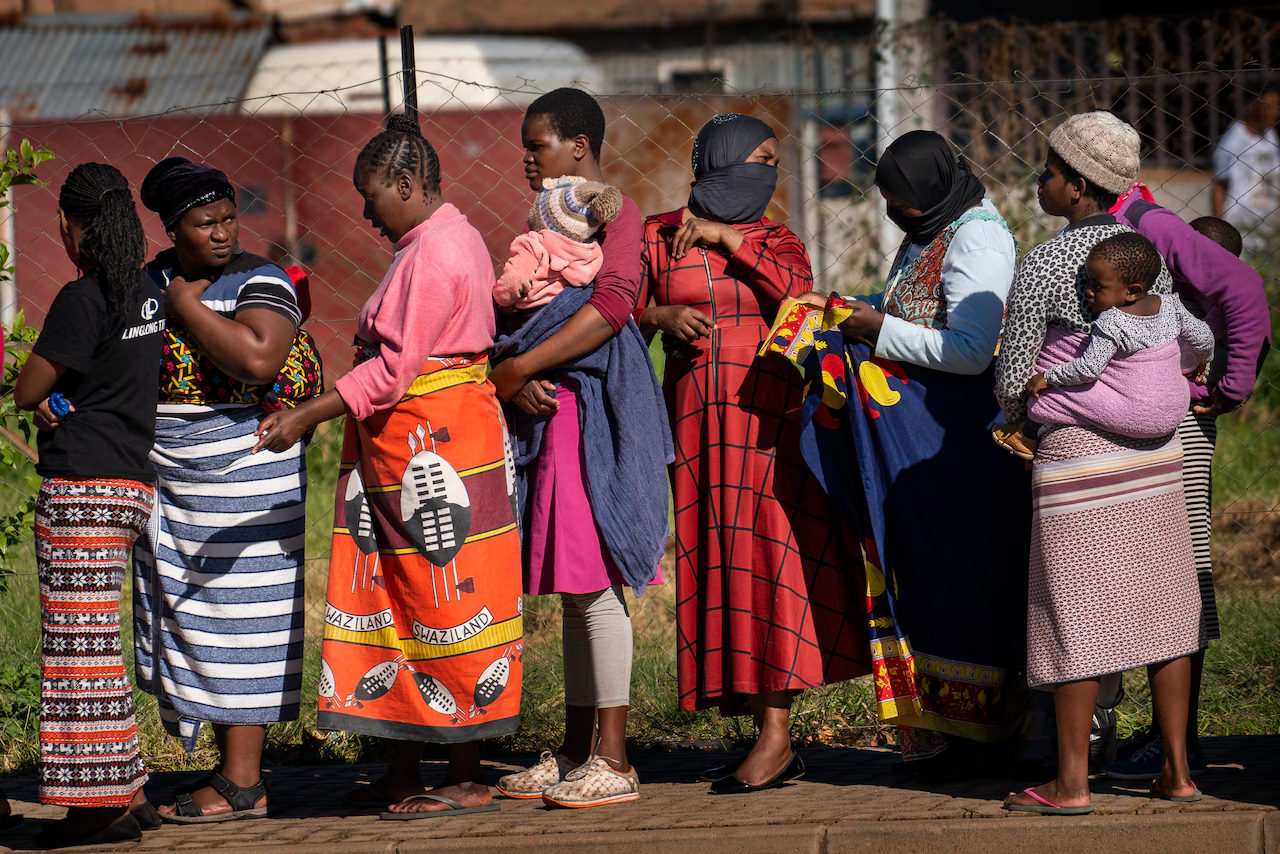
In South Africa, women remain at the sharp end of what is often called the “triple challenge” of unemployment, poverty, and inequality. GEAR has decimated the women dominated textile and garment industry. Only 45% of women participate in the formal economy, most in low-wage sectors such as domestic work, farm labour, and the informal economy. Black African women face the worst discrimination, often supporting unemployed family members on meagre wages.
Austerity measures deepen the crisis, cutting access to healthcare, education, and social services that women depend on. Legal abortion is one thing; access to it is another. Many healthcare facilities are under-resourced, and stigma from health workers often prevents women from seeking care and termination of pregnancy. The situation is even worse for young girls, who are pushed out of school due to teenage pregnancy, sexual violence, or simply because they cannot afford menstrual products. Some schools have even banned pregnant students from continuing their education, reinforcing cycles of poverty and dependence.
‘Wathinta abafazi wathinta mbokodo’ – You strike the woman, you strike a rock
The struggle for gender equality will not be won through legal reforms alone. South Africa’s progressive legal framework exists on paper, but neoliberal economic policies have made many of these rights practically inaccessible to working-class women. If history has taught us anything, it is that rights are not handed down—they are won through struggle.
Historically, women have played a pioneering role in the struggle against colonialism, apartheid and capitalism. Their role in the 20 000 strong march to the Union Buildings to protest against the extension of the pass laws to women on 9th August 1956 is commemorated in National Women Day. Less known is the fact that these were not the first women-led protests against the pass laws. Women repulsed the previous attempt to extend the pass laws to them. In 1913 women led protests in the Free State that lead to victory in 1918. Unrest had spread throughout the province and hundreds of women were sent to prison, and civil disobedience and demonstrations continued sporadically for several years. It was only in 1952 that the newly elected apartheid regime tried again.
Women also pioneered the promotion of non-racial class unity both in 1956 and in the 1973 Durban Strikes which broke the impression of an all-powerful and omnipotent apartheid state. The textile industry, 80% with women 80% of the workforce, was the epicentre of the 1973 strikes. They were the culmination of women keeping the flames of resistance alive under the State of Emergency imposed in 1960 after the Sharpeville massacre. In 1963 in today’s Kwa Zulu Natal the Garment Workers Union forced the employers to cave in to their demands on overtime. A strike over wages and new shifts followed in Benoni in today’s Gauteng in 1964 . The 1973 strikes, in which African, Indian and coloured women united, were preceded by a massive strike wave in 1971 that continued into 1972 – the biggest mobilisation since the 1946 mine workers strike. These strikes raised the confidence of the working-class countrywide culminating in the launch of Cosatu as the most powerful trade union federation in the country’s history at the time. The emblem adopted at Cosatu’s launch includes a woman with a baby on her back – a testament to their role.
Throughout history women have been at the forefront of struggles against oppression and exploitation. Women delegates from 17 different countries gathered on 8th March 1911 – the legacy we celebrate on this day is the struggle against low and discriminatory wages, a shorter working week, the right to vote and for socialism. Six years later in February 1917, Russian women came led the mass uprising to fight for bread, peace and land. A few months later they had set into motion the greatest event in the human history to date – the October Revolution. The Russian working class dismantled capitalism and landlordism and established the first socialist workers state.
The former Soviet Union became the first county in the world where women gained the right to vote, to abortion, to divorce and equal pay. But these were not mere paper rights. Public services were made available to liberate women from domestic burdens. Free education, childcare, laundries and canteens were provided. Theis freed women to participate in the political affairs of society. By the 1980s, 90% of Soviet women formed part of the workforce represented in all industries, disciplines and professions. However, these rights including gay rights began to be reversed in the political counter-revolution Stalin. He was the figurehead of the bureaucratic caste that had sprung up due to the revolution’s isolation. It crushed workers democracy in a political counter revolution. Ultimately, without the oxygen of worker democracy, the planned economy seized up and capitalism was restored in the1990s. Currently women’s participation in the workforce has declined to 49.1%. This experience shows that a socialist revolution cannot succeed in one country. It must be international. Herein lies the significance of the internationalism of International Women’s Day.
Women’s rights will always be precarious under capitalism. Roe v Wade was reversed after 50 years. The permanent eradication of all oppressions including that of women, can only be achieved through workers’ control over society’s wealth and resources and the democratic planning in the collective interests of this makes possible. International Women’s Day must be a day of protest, not just celebration. The struggle for women’s rights is inextricably linked to the fight against capitalism. Women must unite with labour movements, as economic and social struggles are intertwined. Only in unity with the broader working-class movement can capitalism be dismantled and a socialist future be built where true equality can be realized.
A Women’s Platform for Struggle
In November 2024, the Marxist Workers Party (MWP) launched a draft platform for debate within working class communities to unite their struggles over service delivery taking place in isolation. The platform proposes a foundation upon which communities can unite and coordinate their struggles under one umbrella – a United Socialist Civic Federation. We are also developing platforms for the three other theatres of struggles of students and youth, labour, and women. We are making this call and taking these initiatives to unite these struggles from within each theatre. Simultaneously we are campaigning for the unification of all struggles currently taking place in isolation from each other under one umbrella – a mass workers party on a socialist programme. Through the development of a draft platform of demands for women we will be able to unite with others to build a foundation for a Socialist Women’s Federation.
We demand:
. Free, state-funded shelters and housing for survivors of GBV
. An end to secondary victimization of GBV survivors in courts and police stations
. Full reproductive rights and free, accessible abortion services
. Rejection of the Traditional Courts Bill—equality before the law
. Decriminalization of sex work, with support programs for alternative employment
. A minimum wage of R12,500 to end poverty wages
. A universal basic income grant of R4,500
. Six months paid parental leave for all workers
. Free, high-quality early childhood education and safe school transportation
. Permanent jobs for workers on the Expanded Public Works Programme (EPWP)