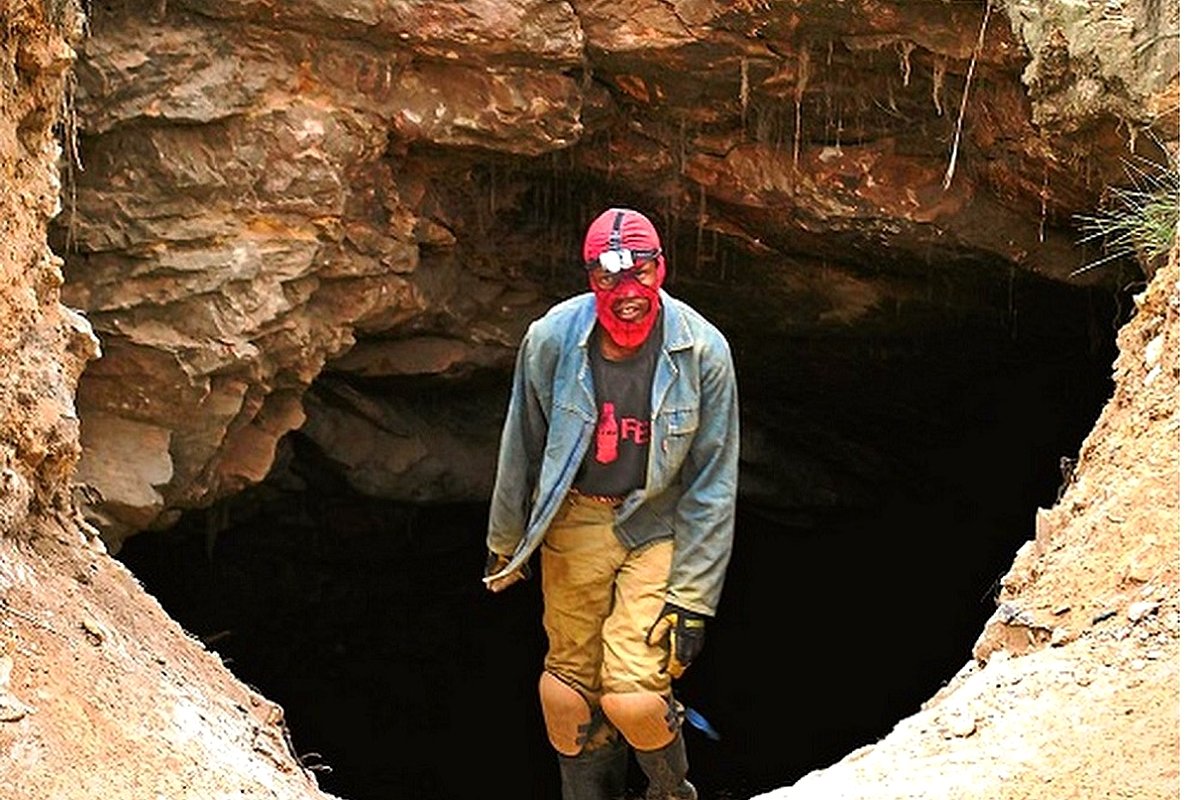
This is a two-part article about the zama zama crisis at Stilfontein in the Northwest, 52 km from Johannesburg. In the first part, which you can access here we discussed the government’s response to the crisis aided by the media in inciting hysteria to dehumanise the trapped workers as foreign criminals. But their hypocrisy was exposed when the community’s efforts to step in to rescue and provide humanitarian relief to the trapped workers made international news headlines. The first part ends by discussing the roots of the rapid expansion of this industry as lying in the huge retrenchments following the Marikana massacre and concludes by arguing that, ultimately, there are no sustainable solutions to this problem based on capitalism. In this second part of the article, which you can access here, we discuss who the real criminals are behind this industry and provide an analysis of the place of artisanal mining in capitalist mining. We conclude by calling for the nationalisation of the whole mining industry under workers’ democratic control and management, as was called for in the Freedom Charter before its abandonment by the ANC.
The ANC’s culpability for the scourge they now denounce as criminal activities carried out by illegal foreigners is shown in its political support for the corrupt regimes in neighbouring countries. Ramaphosa hastened to attend Mnangagwa’s rushed presidential inauguration despite violence and election rigging so blatant that even the SADC election observer team was unable to endorse them as free and fair. Defending the government’s endorsement of the outcome of the recent blatantly fraudulent elections in Mozambique, Deputy President Mashatile denied any knowledge of human rights violations when security forces killed 30, including the assassinating of two opposition figures.
The most glaring example of the government’s dishonesty, cynicism and hypocrisy is the blind eye it continues to turn to the open links between zama zama criminal gang leaders and their funding of political parties in Lesotho. In 2022, Lesotho’s All Basotho Convention (ABC), Nkaku Kabi, campaigned in Klerksdorp, North West, for votes ahead of the country’s 7th October elections. Senior members of the Terene gang, including Sarele Sello, a suspect in the death of 16 people in the Soweto tavern massacre in July that year, had organised the rally attended primarily by Lesotho nationals working in SA. Kabi boasted that his gang sees itself as “a government on its own” with high levels of “organisation and discipline”. There is a cosy relationship between Lesotho’s political parties and its Terene gangs. Named for terene (trains), they were formed after World War 2 by mineworkers who had migrated to SA for work.
They’ve boosted political parties’ popularity by performing at rallies. There are even videos of members distributing cash. Sello had charges against him for the murder of the Lesotho Prime Minister’s wife dropped after a witness could not be found. “ABC and the Terene [ea Khosi Mokata Lirope] are just the same as [the] ANC and Cosatu there in SA. When we go to elections, we go together,” he says (BLive 6/10/2024).
The place of artisanal mining in the capitalist economy
Before this industry became part of big business as it is now, it was characterised by ‘a petty self-exploiting entrepreneurialism’ as one analyst described the nature of this work.
Over 6000 abandoned mines formed part of the backbone of the South African economy, built on extracting precious metals and cheap labour supplied by workers from all over southern Africa. When the mines were no longer yielding the super profits the mining bosses had become accustomed to, they were abandoned or mothballed by their owners with negligible attempts to rehabilitate those areas affected by mining activities. It was not profitable for these companies to invest in technologies that could extract the minerals at deeper levels than could be reached with the existing technologies and human labour. Instead, the mines were abandoned or mothballed and left to pollute the groundwater and the air that mining communities have ingested over the last two hundred years since the colonial regimes discovered diamonds and gold in the 1800s.
Workers from all over southern Africa built South Africa’s economy on the back of mining. Much of the infrastructure, like the railways, ports and harbours, was developed for mining, which spun off the development of the manufacturing and services sectors. This is how South Africa became the economic giant on the continent. The apartheid regime and the ANC government have not held the mining conglomerates accountable for the trail of destruction left in mining-affected areas wracked by poor air quality, contaminated water and joblessness. Instead, some members of the post-apartheid black elite have joined their ranks as junior partners of these multinationals in the minerals and energy complex. There is very little to show for the people who toiled for most of their lives in one of the most demanding jobs, making super profits possible before the mine closures.
The work of the zama zamas is an extreme form of the precarious nature of work that dominates capitalism after 40 years of neoliberalism, not only in South Africa but internationally. The criminal syndicates who work with corrupt government officials and multinational companies contribute to the billions of illicit capital flows out of the country annually. They fund conflicts and wars that rage throughout many parts of the continent.
Although many of the conflicts in African countries result from extreme poverty and unemployment arising from the crisis of capitalism, they are also fuelled by the struggle for control of the rich resources in countries such as the DRC, Nigeria, and Mozambique. Neighbouring countries are caught up in proxy wars through rebel groups that are funded by the illegal mining and extraction of other resources. The UAE-funded Rapid Support Forces that is terrorising Sudan and is involved in smuggling Sudanese gold is just one example. The UAE has been significantly involved in the ongoing conflict in Sudan, primarily by supporting the Rapid Support Forces (RSF). This support includes supplying weapons and ammunition, which has helped the RSF sustain its fight against the Sudanese Armed Forces (SAF).
The neo-imperialists Russia and China, along with their quislings like the UAE, Saudi Arabia, and Egypt, and American and French imperialism, although with declining influence, aggravate the crisis. Their interests are tied to the conflicts in the region funded by illegal trade in all the continent’s rich resources in what can only be described as a new scramble for Africa.
There is a direct link between the decline in formal mining and the growth of the artisanal mining sector. Gold mining, for example, peaked after the 1970s during the boom of capitalism. Its steady decline since then is the result of the general fall in profits at the end of the boom, including, among others, fluctuating prices, increased costs associated with older mines, as well as labour and other variables. Therefore, profits for those who control this industry can only be extracted based on the working class’s immiseration through extreme exploitation to exact profits comparable to the past.
These conditions of accumulation are not new to capitalism but represent a return to its true nature of naked greed obfuscated over several decades by the pretensions of an “international rules-based order” after World War II. It is wrapped up in hypocritical language about “human rights” and “democracy.” As Karl Marx famously reminds us, capitalism entered the scene of history ‘dripping from head to foot, from every pore, with blood and dirt’ of exploitation of the European working class before it exported and perfected these methods through slavery and colonialism throughout the world.
They have maintained their rule by dividing the working class and maintaining an ideological grip on society through various institutions, including the media and other “soft power” institutions like the National Endowment for Democracy, USAID, and European equivalents.
The ideological degeneration that infected the leadership of trade unions and parties that stood for socialism , following the collapse of Stalinism (a caricature of socialism) meant no resistance was offered to the capitalist class’s neo-liberal onslaught. Thus, the ground has become fertile for reactionary political forces promoting xenophobia, misogynism, racism, and other forms of dividing the working class by the elites in society.
How can the crisis be overcome?
The MWP supports demands that artisanal mining be regulated by the state to provide communities with sustainable, decent, and dignified work. Rights the working class won through the struggle to protect them, such as the Basic Conditions of Employment, and the Labour Relations Acts, must be applied to the sector.
However, artisanal mining is profitable precisely because it disregards the fundamental rights of workers enshrined in these laws. Therefore, such activities can only sustain decent work and conditions through the nationalisation of the mining industry under democratic control and management of the working class.
In a community such as Stilfontein, direct involvement of the community with representation from the state and labour could plan for production based on need and not profit. In these circumstances, it would be possible for the state to embark on a mechanisation programme to reach the depths of mines required to extract mineral deposits without risking workers’ lives in unsafe and dangerous conditions. The rehabilitation of the mining areas would be carried out with the community’s direct involvement, which could stimulate economic activities that employ those workers replaced by mechanisation. However, the nationalisation of the mining industry will not survive as an island in the sea of a capitalist economy. The entire economy would have to be nationalised under workers’ control and management. That, in turn, poses the need for a workers’ government led by a mass workers’ party on a socialist programme.
It would be naive, however, to expect the ANC government to suddenly undergo a conversion on the road to Damascus, abandon the church of capitalism it has worshipped all its life and serve the people instead. After the Freedom Charter was adopted at the Congress of the People in Kliptown in 1955, Mandela defended the charter’s nationalisation clauses by pointing out that “the financial and gold mining monopolies and farming interests …have for centuries plundered the country and reduced its people to servitude … (that) such a step is imperative and necessary because the realisation of the charter is inconceivable, in fact impossible, unless and until these monopolies are first smashed up, and the national wealth of the country turned over to the people.”
But as Mandela made clear in arguably his most emphatic rejection of socialism, “nationalisation would open fresh fields for developing a prosperous non-European bourgeoisie … and private enterprise would flourish as never before.” (His article “In Our Lifetime”, published in Liberation, June 1956).
The capitalist ANC leadership’s capitulation, led by Mandela in his 1992 television announcement that privatisation has now become the ANC’s fundamental policy, has perpetuated the very plunder of not just SA but the subcontinent and the servitude of its people he had denounced so stridently in 1956.
The community in Stilfontein has demonstrated how easily xenophobia and the criminalisation of these artisanal workers can be replaced by the solidarity that is instinctive to the working class. These efforts have to be built upon and extended to the wider community of Stilfontein and exported to other mining-affected areas to build a movement that can address the immediate problems, which, in the final analysis, can only be sustained through the socialist transformation of society.
MWP encourages the community members who have offered support and solidarity to the mineworkers to lead a campaign based on the following demands:
- Community to take the lead in rescue operations with the support of the professional rescue team and funding set aside for the rehabilitation of the mines.
- Communities to support a call for amnesty for the remaining mineworkers and those arrested.
- The state to arrest and prosecute the leaders of the criminal syndicates who own and control the illegal operations.
- Immediate implementation of the proposed amendments to the Mineral and Petroleum Resources Development Act (MPRDA) to regulate the ASM sector.
- Rehabilitation of mining areas must include addressing the most pressing needs of those communities by creating decent jobs and providing quality health, education, and services.
- Support from the labour federations to participate in the structures that must be established to lead a programme of nationalisation of mines.
- Nationalise the mines under workers’ democratic control and management, starting with rehabilitating the mining areas and creating jobs.
Unite the working class struggle in communities, the workplace and the education sector under a mass workers’ party on a socialist programme.